













The agency calendar looks healthy. Developers are assigned to projects, a new client has signed, and another proposal is waiting for approval. Then an important customer reports a production issue. A designer needs a decision before work can continue. A promising prospect asks whether the team can start next month.
Suddenly, a full calendar looks less like a sign of strength and more like a warning. There is no obvious place for the work that was not scheduled—and no easy way to take an opportunity without disrupting an existing commitment.
For a web agency, capacity is more than the number of developers multiplied by their working hours. It is the ability to deliver the right work, with the right skills and decisions available when they are needed.
The difference between assigned time and usable capacity
Imagine an agency with three developers. Each has a 40-hour week, so the calendar appears to offer 120 hours. That figure is a starting point, not a promise that 120 hours can be sold to clients. Meetings, reviews, training, internal administration, leave, and support all compete for time.
The same is true of attention. A developer assigned to four small projects may lose time switching contexts and waiting for answers. A project can also be “staffed” on paper while depending on the one person who understands its payment integration.
Map the work by capability as well as by person. Who can review a database change? Who can communicate with the client? Who can deploy the application? A team may have spare hours overall while a particular skill is already overloaded.
Look at the work that never appears in the proposal
Agencies often plan around visible deliverables: a new checkout, an administration screen, or a design refresh. Less visible work still needs a place in the week. Client questions, code review, release coordination, accessibility checks, and support for colleagues are part of delivery, even when they are not separate line items.
For a few weeks, compare the plan with what actually happened. The aim is not to monitor every minute. It is to discover recurring obligations that should be represented in future planning. If the team regularly spends time investigating third-party integration failures, a capacity plan that ignores that work will remain optimistic.
Make room for uncertainty
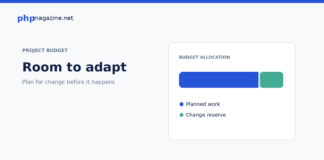
Leave some capacity uncommitted and decide what it is for. One agency may need room for production support; another may reserve time for code review, sales conversations, or helping a junior developer. The appropriate amount depends on the nature of the work and the commitments already made.
Uncommitted time should not be treated as an automatic invitation to add another deadline. When no incident arrives, the team can use it for useful work such as improving a deployment process or reducing a known source of support requests. If urgent work does arrive, the agency has a way to respond without immediately sacrificing every other commitment.
Use a simple decision rule
Before accepting a new project, identify who will do the work, who will review it, and which existing commitment will move if the new project starts on the requested date. If nobody can answer, the problem is not solved by adding the project to the calendar.
The agency can offer a later start, reduce the initial scope, bring in a qualified collaborator, or decline. Each option has a cost. Making that cost visible is better than quietly assuming the team will absorb it.
A healthy schedule is not one in which every hour is assigned. It is one in which the agency can meet its promises and still make thoughtful choices when the unexpected—or an excellent opportunity—appears.