The PHP development team has released updated Windows builds to address a security vulnerability in Brotli, a compression library used by several software platforms. The announcement, published on October 26, 2026, comes just five days after PHP’s emergency security releases addressing two critical vulnerabilities in the language runtime.
This time, however, the problem is different. The vulnerability does not originate in PHP’s source code. It affects a third-party library included in the official Windows distributions.
The distinction is important because developers relying exclusively on PHP_VERSION or the output of php -v may not be able to determine whether their installation contains the updated dependency.
What Has Been Released?
The PHP team has published four updated Windows package versions:
- PHP 8.5.12-1
- PHP 8.4.27-1
- PHP 8.3.36-1
- PHP 8.2.35-1
These packages include Brotli 1.2.1, which addresses CVE-2026-111497, an out-of-bounds write vulnerability in the Brotli decoder.
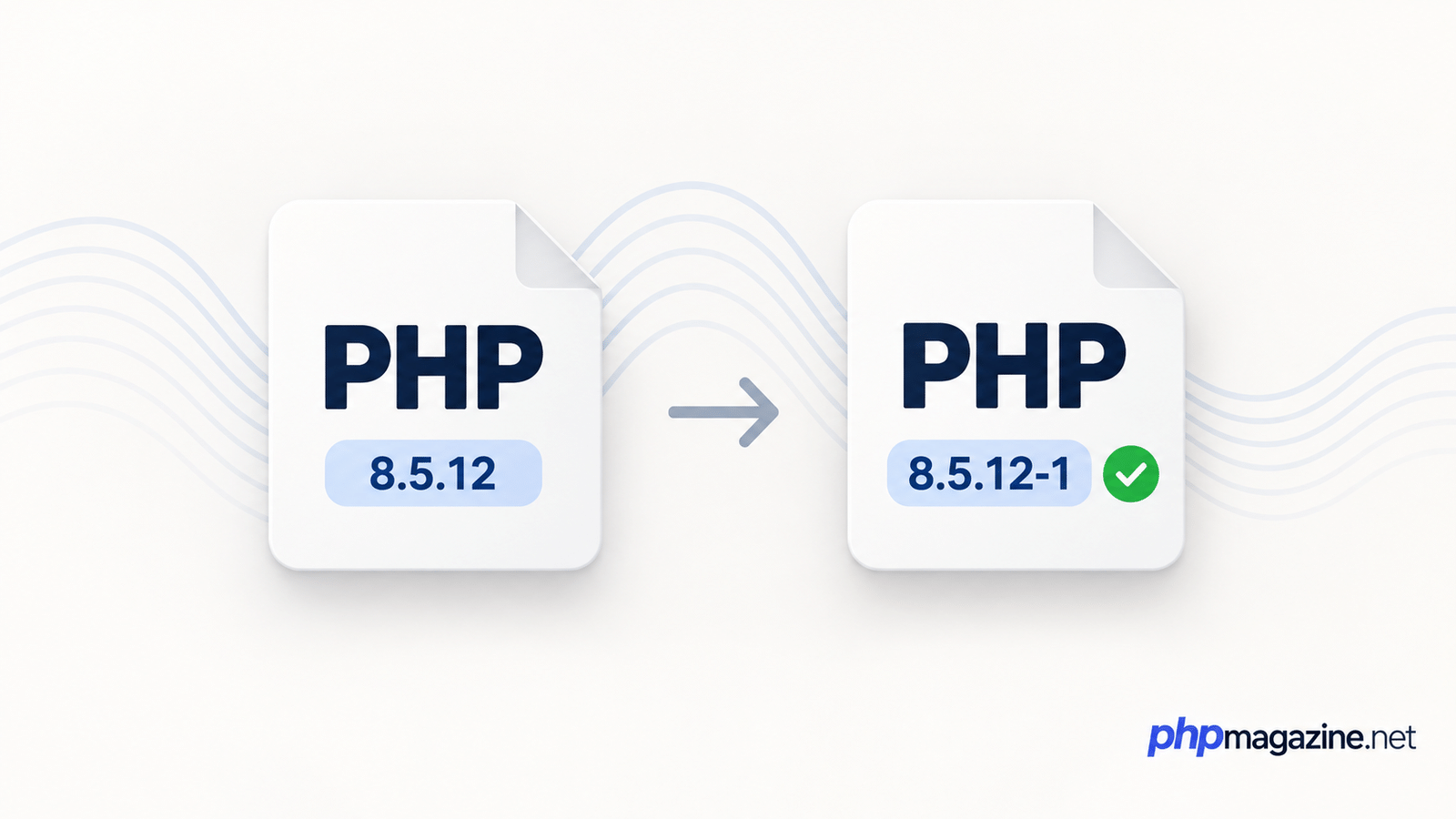
The -1 suffix identifies a Windows package rebuild. It does not represent a new PHP language release, and the underlying PHP source versions remain unchanged.
Consequently, an installation using PHP 8.5.12-1 still reports PHP 8.5.12 as its runtime version.
For organizations maintaining inventories of PHP installations, this creates an important distinction between the language version and the actual binary distribution deployed on a server.
Understanding the Brotli Vulnerability
Brotli is a compression algorithm commonly used to reduce the size of web resources transferred over HTTP. Browsers and HTTP clients can request Brotli-compressed responses, reducing network traffic when servers support the format.
The vulnerability identified as CVE-2026-111497 affects the decoder responsible for decompressing Brotli data.
According to the published security advisory, a specially crafted compressed stream can trigger memory corruption. Depending on the affected software and execution context, the consequences may include process crashes, information disclosure, or potentially arbitrary code execution.
These are potential impacts of the underlying decoder vulnerability, not a claim that every PHP installation can be exploited remotely.
The PHP announcement identifies a specific exposure path: the cURL extension on Windows can invoke the affected Brotli decoder when automatic HTTP response decompression is enabled.
How PHP Applications Can Reach the Decoder
PHP applications frequently use cURL to retrieve API responses, download files, or communicate with external services.
By default, libcurl does not enable automatic HTTP response decompression through its CURLOPT_ACCEPT_ENCODING option. However, applications and HTTP client libraries can enable this behavior.
For example, the following configuration asks libcurl to negotiate all compression formats supported by its build:
<?php

$ch = curl_init('https://example.com/api/data');

curl_setopt(
    $ch,
    CURLOPT_ACCEPT_ENCODING,
    ''
);
The empty string is significant. It tells libcurl to advertise the compression formats available in the installed library and automatically decompress supported responses.
When Brotli support is present, this can include Brotli-compressed content.
Applications may also enable automatic decompression indirectly through HTTP client libraries. Developers should therefore examine their actual dependency configuration rather than assuming the default cURL behavior always applies.
Checking Brotli Support from PHP
PHP provides the curl_version() function, which exposes information about the underlying libcurl installation and supported features.
A small diagnostic script can help identify the Brotli version reported by libcurl:
<?php

declare(strict_types=1);

if (!extension_loaded('curl')) {
    fwrite(STDERR, "cURL extension unavailable\n");
    exit(1);
}

$curl = curl_version();

if ($curl === false) {
    fwrite(STDERR, "Cannot inspect libcurl\n");
    exit(1);
}

printf(
    "PHP version: %s\n",
    PHP_VERSION
);

printf(
    "libcurl version: %s\n",
    $curl['version'] ?? 'unknown'
);

printf(
    "Brotli version: %s\n",
    $curl['brotli_version'] ?: 'not available'
);
This script provides useful diagnostic information, but it is not a complete security verification tool.
In particular, it does not identify the official Windows package rebuild suffix, and the reported dependency information must be interpreted in the context of the actual installation.
For managed environments, administrators should verify the source of the installed binaries, their package versions, and the dependencies actually loaded by running PHP processes.
Why php -v Is Not Sufficient
Most PHP administrators begin a version audit with:
php -vThat remains useful for identifying the PHP runtime version. It does not necessarily establish whether every bundled library has received its latest security update.
In this case, PHP 8.5.12 and PHP 8.5.12-1 share the same PHP source release but contain different dependency versions in their official Windows packages.
The appropriate verification process is therefore to identify the actual package installed and compare it with the official Windows downloads.
Administrators downloading packages manually should also verify their integrity using the published SHA-256 checksum.
On Windows PowerShell, this can be done with:
Get-FileHash .\php-package.zip -Algorithm SHA256The resulting hash should match the checksum published alongside the exact package on the official PHP downloads page.
What Should Developers Do?
Windows users running official PHP distributions should install the updated packages corresponding to their PHP branch, architecture, and thread-safety configuration.
For example, an application using the Non Thread Safe build under IIS should not switch arbitrarily to a Thread Safe package. The replacement must remain compatible with the existing server configuration and installed extensions.
After replacing the binaries, restart the relevant services and verify that the application is using the updated installation.
Developers using third-party Windows distributions or package managers should consult their distribution maintainers. The PHP project’s rebuild announcement applies specifically to its official Windows packages.
Similarly, Linux distributions may use system-provided libraries and apply security fixes through their own package-management processes. Their package versions and update procedures should not be inferred from the Windows announcement.
A Broader Lesson About Runtime Dependencies
The Brotli update illustrates a recurring challenge in software maintenance: a runtime is more than its language interpreter.
PHP installations depend on libraries providing cryptography, networking, compression, database connectivity, and other capabilities. A vulnerability in one of these components can require a distribution update even when the PHP source code itself has not changed.
For teams maintaining production systems, this is a strong argument for tracking binary provenance, package revisions, and third-party dependencies alongside application and language versions.
Conclusion
The October 26 Windows rebuilds are a targeted security response to a vulnerability in a bundled compression library.
The immediate action is straightforward: Windows administrators using affected official packages should move to the updated builds.
The longer-term lesson is equally important. Knowing the PHP version is necessary, but it is not always sufficient to establish the security state of an installation.
Effective runtime maintenance requires visibility into the complete software distribution, including the native libraries on which applications depend.
Official References
- PHP Development Team — Updated Windows Builds, October 26, 2026
- PHP Official Windows Downloads
- CVE-2026-111497 — Brotli Security Advisory
- PHP Manual — curl_version()