Infrastructure as Code tools have made cloud deployments considerably more predictable, but one fundamental limitation remains: not everything is known before infrastructure is created.
A cloud provider may assign a resource identifier only after creation. An API may return a value whose exact content cannot be determined during planning. These unknown values can propagate through infrastructure configurations, sometimes preventing useful validation until the deployment is already underway.
OpenTofu 1.13, released on September 29, 2026, introduces several functions designed to address part of this problem. Alongside improved platform support and early experiments with built-in linting and reusable symbol libraries, this release offers infrastructure developers more ways to describe what they know about values that have not yet been computed.
A Release Focused on Practical Improvements
OpenTofu 1.13 is not a major architectural overhaul. The project describes it as a relatively light release, following a shorter development cycle intended to align more closely with the Go release schedule.
According to the release announcement, the 1.13 series is expected to receive security support until August 2027. The release also introduces official Windows ARM64 builds, expands its expression language, and includes early work on tooling capabilities that remain experimental.
For teams already managing production infrastructure with OpenTofu, the most interesting changes may be those affecting how configuration expressions behave during the planning phase.
The Challenge of Unknown Values
Consider a configuration that creates an AWS virtual private cloud. The provider normally determines the final VPC identifier only after the resource has been created.
During planning, an output may therefore contain an unknown value:
output "vpc_id" {
  value = aws_vpc.main.id
}
This is expected behavior. Infrastructure tools must avoid pretending that values are known before the provider has supplied them.
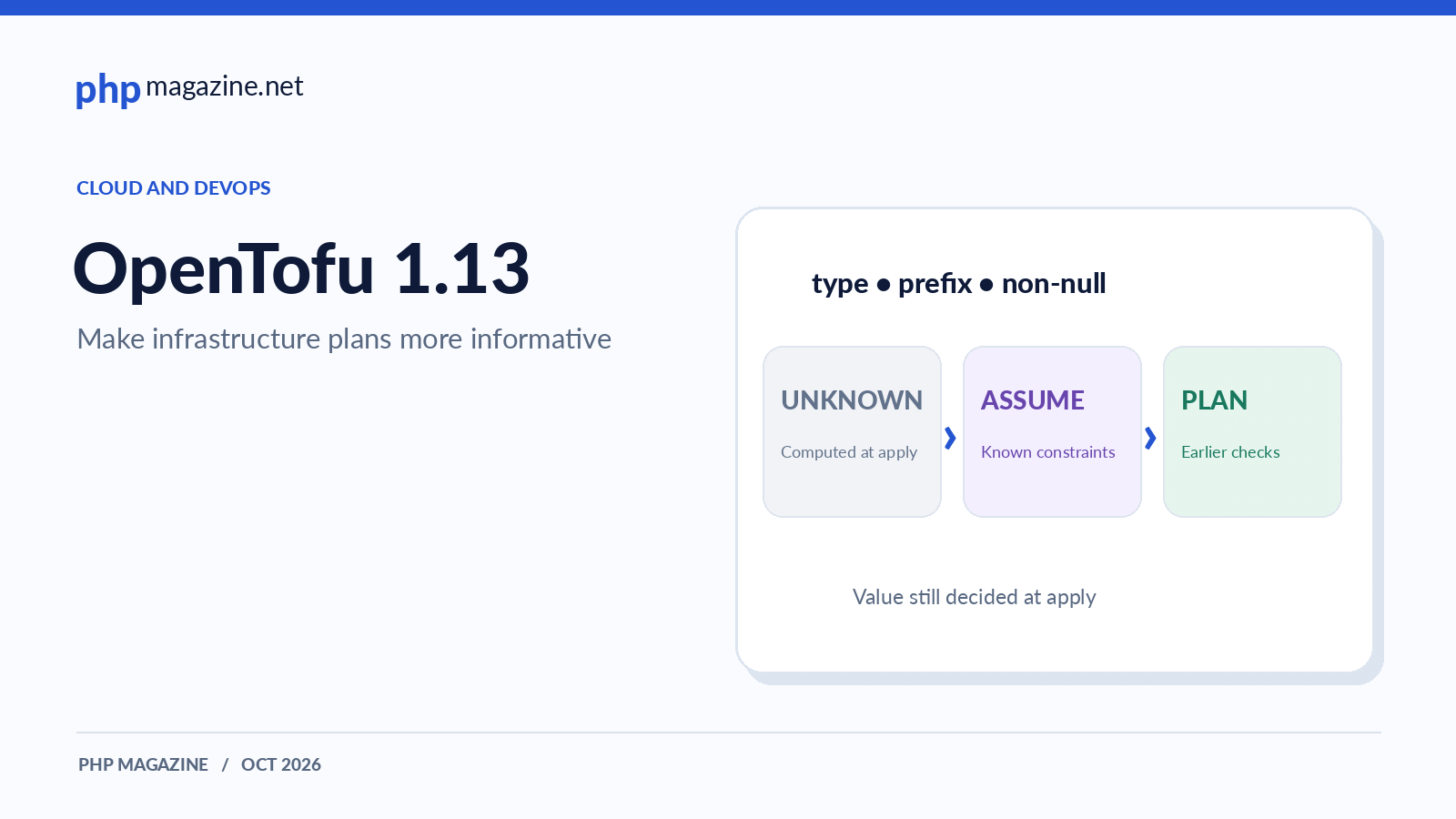
However, an unknown identifier may still have predictable properties. For example, AWS VPC identifiers follow a recognizable prefix convention, even when the complete identifier is not yet available.
OpenTofu 1.13 introduces functions that allow module authors to make certain assumptions explicit, providing additional information to the planning engine.
Introducing the assume Functions
The new family of assume... functions allows developers to describe properties of values that are not yet finalized.
For example, when an AWS VPC resource is defined elsewhere in a configuration, we can express that its identifier is expected to be non-null and begin with a known prefix:
output "vpc_id" {
  value = assumenotnull(
    assumestringprefix(
      aws_vpc.main.id,
      "vpc-"
    )
  )
}
The assumestringprefix() function declares an expected string prefix, while assumenotnull() indicates that the final value must not be null.
When the actual value becomes available, OpenTofu checks whether these assumptions hold. If they are violated, the operation fails rather than silently accepting an incorrect result.
These functions do not generate a resource identifier, and they do not force the cloud provider to reveal it earlier. They allow OpenTofu to reason about certain properties of a value while its exact contents remain unknown.
Why This Matters for Module Authors
Reusable infrastructure modules often expose outputs consumed by other modules. If those outputs are entirely unknown during planning, downstream expressions may also become unknown, even when some useful properties can already be established.
Explicit assumptions can make these relationships easier to evaluate. For example, a consuming module might be able to determine that an identifier is not null without waiting for the entire identifier to be returned by the provider.
This can help OpenTofu evaluate conditional expressions and validation rules earlier in the deployment process.
Earlier validation is valuable because discovering a configuration problem during planning is generally less disruptive than encountering it halfway through infrastructure creation.
However, the OpenTofu documentation is careful not to promise that every problem will be detected during planning. The result depends on the available information, provider behavior, and the expressions involved.
Explicit Type Conversion with convert()
Another addition in OpenTofu 1.13 is the convert() function. It explicitly converts a value to a specified type constraint.
Consider a module that receives a JSON configuration containing a service name and a set of labels:
variable "service_payload" {
  type = string
}

locals {
  service = convert(
    jsondecode(var.service_payload),
    object({
      name   = string
      labels = map(string)
    })
  )
}
If the JSON input is known, OpenTofu can decode it and validate whether it conforms to the expected structure. If the input is unknown during planning, the converted result can still carry useful type information even though its actual values remain unknown.
This makes the function particularly interesting for modules processing dynamic configuration data or provider outputs containing JSON.
It is important to remember that OpenTofu already performs many type conversions automatically. The new function is not intended to replace ordinary type declarations, but to handle situations where the expected result is ambiguous or cannot otherwise be inferred.
Experimental Linting and Symbol Libraries
Beyond the expression language, OpenTofu 1.13 includes early work toward built-in linting and a feature described as Symbol Libraries.
These initiatives are still experimental. They should not be confused with fully established functionality that teams can immediately depend on in production workflows.
The direction is nevertheless worth following. Infrastructure development increasingly resembles conventional software development, with reusable modules, shared conventions, automated validation, and code review processes.
Integrating more analysis capabilities directly into infrastructure tooling could eventually simplify parts of this workflow. But established external linters, security scanners, and policy tools continue to serve important purposes today.
Compatibility and Upgrade Considerations
Teams upgrading to OpenTofu 1.13 should review the release notes carefully, particularly when maintaining shared automation environments or using provisioners.
One compatibility change concerns the base64gzip() function, whose output can differ slightly from previous releases. Configurations depending on exact encoded output should be tested.
Another change is the removal of WinRM support for provisioners. Organizations still depending on that mechanism need to examine their workflows before upgrading.
A sensible upgrade process includes testing representative configurations in a non-production environment, reviewing plans for unexpected changes, and validating provider compatibility before modifying shared deployment pipelines.
Do More Assumptions Mean More Reliability?
There is an important distinction between documenting a known constraint and inventing certainty where none exists.
Assumption functions are useful only when their constraints are supported by a reliable contract, such as a provider’s documented behavior or a stable external API specification.
Incorrect assumptions do not make infrastructure more predictable. They merely postpone the discovery of an invalid expectation until the actual value becomes available.
Module authors should therefore use these functions selectively, document the underlying assumptions, and test failure scenarios as well as successful deployments.
Conclusion
OpenTofu 1.13 is a relatively modest release, but its improvements to unknown-value handling address a practical problem in Infrastructure as Code development.
Functions such as convert(), assumenotnull(), and assumestringprefix() allow module authors to express more information about values that are not fully determined during planning.
The result is not a system that knows the future. It is a planning engine that can sometimes make better decisions based on constraints developers already understand.
For infrastructure teams, that is a useful direction: clearer configurations, more meaningful plans, and potentially earlier detection of problems, without confusing assumptions with actual results.