Node.js is entering a new phase in its release strategy. Beginning with Node.js 27, the project is moving from two major releases per year to one, while introducing an Alpha channel and eliminating the distinction between odd-numbered and even-numbered release lines.
The new schedule begins its transition in October 2026, with the Node.js 27 Alpha cycle scheduled to start on October 28. The first stable Node.js 27 release is planned for April 2027, followed by Long-Term Support later that year.
This is more than a change in version numbering. It reflects how the JavaScript server ecosystem has evolved, how developers adopt new releases, and how a largely volunteer-maintained project manages its long-term support responsibilities.
Why Node.js Is Changing Its Release Schedule
For approximately a decade, Node.js followed a predictable pattern: two major versions each year, with an even-numbered release in the spring and an odd-numbered release in the autumn.
Even-numbered releases eventually entered Long-Term Support, while odd-numbered releases had comparatively short lifetimes.
This arrangement gave developers early access to new functionality while providing production environments with a stable release line.
However, the Node.js Release Working Group has acknowledged that adoption patterns have changed.
Many organizations avoid odd-numbered releases entirely, preferring to wait for LTS versions. As a result, the project has been maintaining release lines that receive relatively limited production adoption.
Maintaining multiple active versions also creates substantial work for the project’s contributors, particularly when security vulnerabilities require patches across several branches.
The revised schedule attempts to simplify this situation without sacrificing the predictability that enterprise users expect.
One Major Release Every Year
Starting with Node.js 27, the project will publish one major stable release each April.
Every major version will eventually enter Long-Term Support. The previous distinction between odd-numbered and even-numbered releases will disappear.
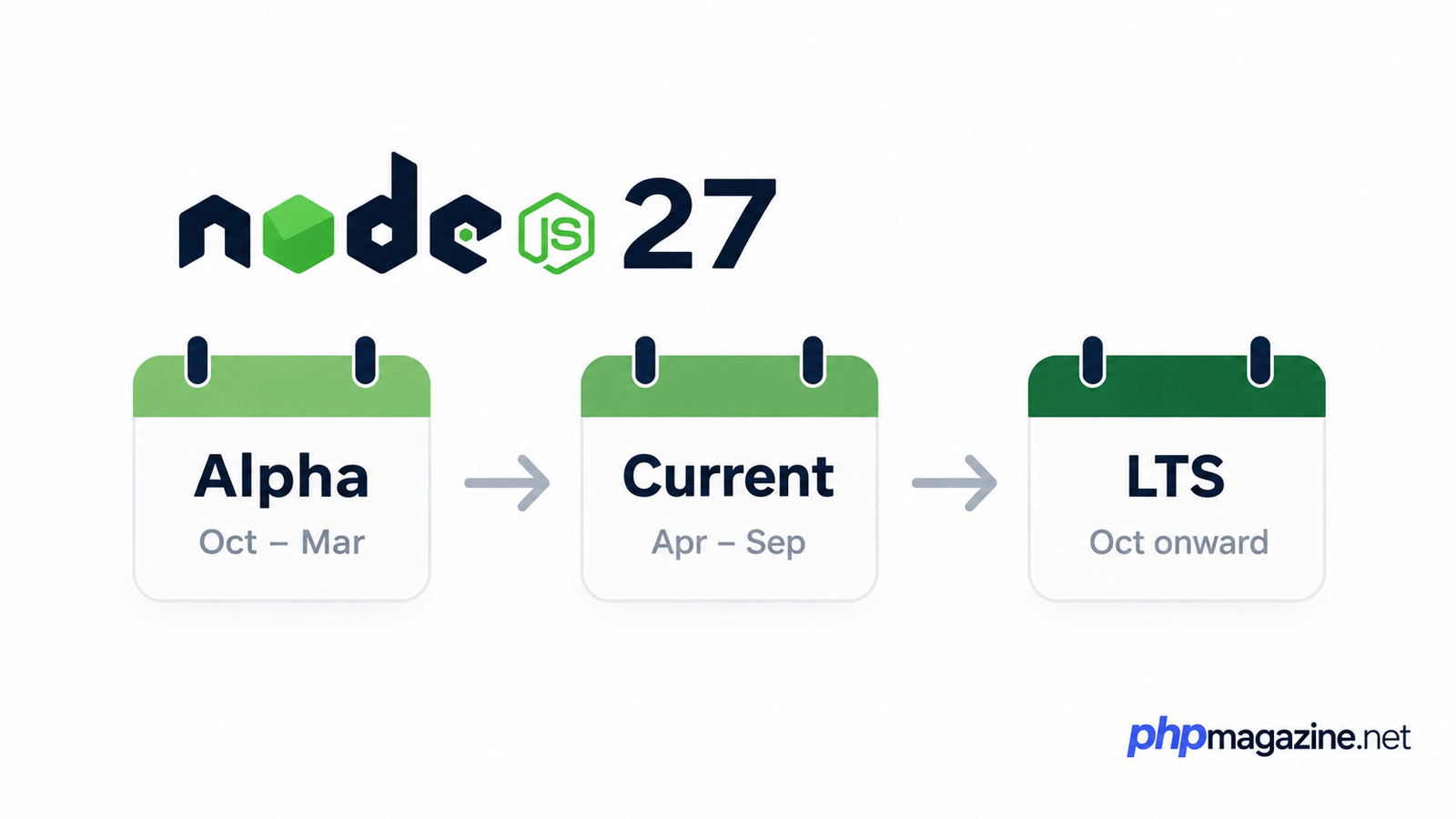
Under the new model, each release line moves through three principal phases:
- Alpha: Approximately six months, beginning in October, for early compatibility testing and potentially breaking changes.
- Current: Approximately six months, beginning with the stable major release in April.
- LTS: Approximately 30 months of long-term support, beginning in October.
The project plans approximately 36 months of support from the first stable major release to end of life.
For production users who already wait for LTS releases, the practical upgrade rhythm remains broadly similar. The main difference is that every annual major version will now follow the path to LTS.
Node.js 27 Introduces the Alpha Phase
The most significant addition is the new Alpha channel.
Unlike traditional nightly builds, Alpha releases are intended to be signed, tagged, and tested through the project’s established compatibility-testing infrastructure.
They are designed primarily for library maintainers, framework developers, and teams responsible for compatibility testing.
During the Alpha phase, the project may introduce semver-major changes. APIs and binary interfaces may therefore change between Alpha releases.
This flexibility gives maintainers an opportunity to identify compatibility problems before the stable major release.
It also creates a clearer distinction between experimental compatibility testing and production deployment.
The Release Working Group explicitly states that Alpha builds are not intended for production use.
The Node.js 27 Timeline
According to the project’s published release schedule, the principal milestones for Node.js 27 are:
- October 28, 2026: Scheduled beginning of the Alpha cycle.
- April 22, 2027: Planned first stable Node.js 27 release.
- October 20, 2027: Planned transition to LTS.
- April 30, 2030: Planned end of support.
These dates represent the project’s current schedule and may change.
Importantly, the start of a scheduled Alpha phase should not be confused with confirmation that a particular Alpha binary is available for download. Developers should consult the official release channels before installing a prerelease build.
What Happens to Node.js 26?
Node.js 26 remains the final release line under the previous schedule.
Its LTS transition is scheduled for October 28, 2026. The project’s release-status page still identifies the latest published Node.js 26.12.1 build, released on October 21, as a Current release.
Node.js 26 is expected to enter maintenance in October 2027 and reach end of life in April 2029.
Teams using Node.js 24 LTS should not interpret the arrival of Node.js 27’s Alpha cycle as a requirement to upgrade immediately.
Production upgrade decisions should continue to follow supported release status, dependency compatibility, application requirements, and operational testing.
Why Library Maintainers Should Pay Attention
The new Alpha phase is especially relevant for maintainers of npm packages, web frameworks, native addons, and development tools.
Under the previous model, many projects tested compatibility against Current and LTS versions, while odd-numbered releases provided an additional opportunity to identify upcoming changes.
With the new annual schedule, maintainers who test only against LTS releases may discover compatibility problems much later in the development cycle.
The Node.js project therefore encourages library authors to incorporate Alpha releases into their continuous integration workflows as early as practical.
Such tests should generally be treated as experimental compatibility checks rather than mandatory production release gates.
A failure against an Alpha build may reveal an upcoming breaking change, but it may also reflect behavior that will change again before the stable release.
A More Predictable Upgrade Strategy
For application teams, the new schedule creates an opportunity to simplify version-management policies.
Instead of tracking alternating short-lived and long-lived major releases, organizations can plan around a yearly stable release followed by a predictable LTS transition.
A practical strategy is to maintain production environments on supported LTS versions, test upcoming stable versions before their LTS promotion, and use Alpha builds only in isolated compatibility-testing environments.
Teams should also review their package engine constraints, CI matrices, container base images, and native dependencies whenever a new major release approaches.
For applications using native addons, binary compatibility deserves particular attention because a new major Node.js version can introduce changes that require updated dependencies or rebuilt binaries.
A Sustainability Decision as Much as a Technical One
The release schedule also reflects an important reality of open-source infrastructure: maintenance capacity is finite.
Node.js is a widely deployed runtime, but much of its maintenance work is performed by volunteers.
Supporting fewer concurrent release lines can reduce the complexity of backporting security fixes, testing compatibility, and preparing releases.
The objective is not simply to release software less frequently. It is to allocate development and maintenance effort more effectively while preserving the reliability expected by production users.
Conclusion
The move to annual major releases represents a meaningful evolution in how Node.js balances innovation, compatibility, and long-term maintenance.
For production application developers, the transition should preserve much of the familiar LTS upgrade rhythm.
For library maintainers, the new Alpha channel creates an earlier opportunity to test compatibility and report problems before they reach stable releases.
Node.js 27 will be the first major release to follow this model. Its success will depend not only on the release process itself, but also on how effectively the broader JavaScript ecosystem uses the additional testing window.