
















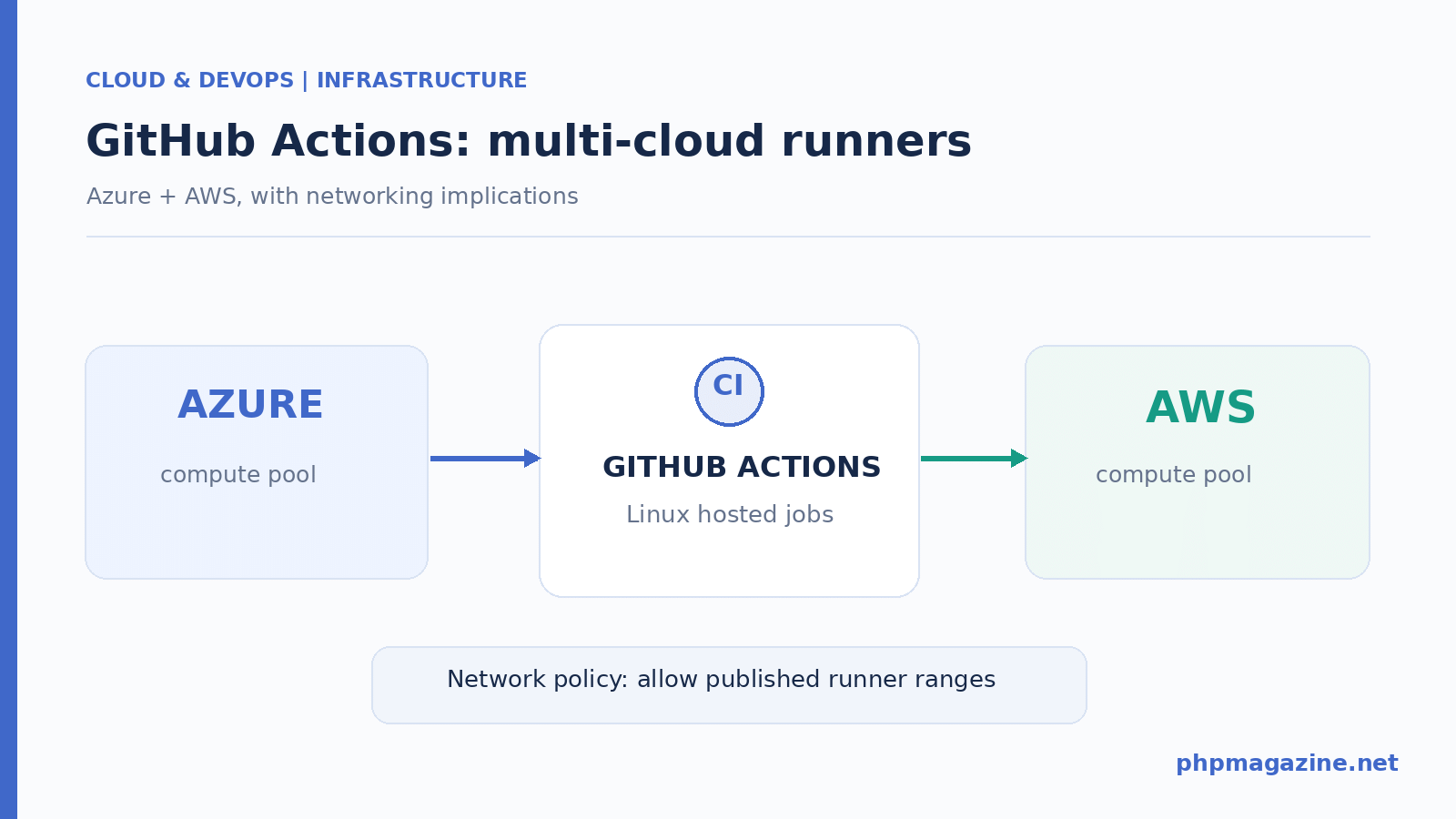
GitHub Actions is expanding its hosted runner infrastructure beyond Microsoft Azure, introducing Amazon Web Services as an additional compute provider for eligible Linux jobs. Announced on October 28, 2026, the change is intended to increase available capacity, reduce queue times during peak demand, and improve the resilience of GitHub’s CI/CD service.
For many developers, the transition will be almost invisible. Existing workflow files and runner labels continue to work, and GitHub determines where eligible jobs execute.
However, organizations that depend on network restrictions, IP allowlists, or cloud-provider-specific security policies may need to review their configurations before the rollout reaches their repositories.
The important change is not in the GitHub Actions workflow language. It is in the infrastructure and network identity of the machines executing those workflows.
Why GitHub Is Expanding Its Compute Infrastructure
GitHub Actions executes builds, tests, and deployment jobs for an enormous variety of software projects. Its hosted runners provide managed execution environments, allowing developers to use CI/CD without administering their own build servers.
Like any shared compute service, GitHub Actions must manage uneven demand. Large releases, popular development workflows, and periods of increased activity can place pressure on available runner capacity.
GitHub’s new multi-cloud scheduling model expands the pool of compute resources available for eligible jobs.
Instead of depending entirely on one underlying cloud provider for those runners, GitHub can allocate suitable work across Azure and AWS infrastructure.
The announced objective is better availability and capacity management. GitHub has not published a universal performance guarantee or benchmark demonstrating that every individual workflow will complete faster.
Which Runners Are Affected?
The change applies to standard Linux runners with two or four CPU cores and compatible larger Linux runners with two or four cores that do not require specialized configurations.
It does not apply to Windows runners, runners using private networking, or other specialized runner configurations.
For GitHub Free, Pro, and Team customers, eligible jobs automatically become candidates for multi-cloud scheduling.
GitHub Enterprise Cloud customers can opt in through enterprise settings, under Actions and Hosted compute cloud providers.
Importantly, developers do not select AWS or Azure through a new workflow field. GitHub handles cloud placement automatically for eligible jobs.
Existing Workflow Files Remain Valid
Consider a standard workflow that runs tests on Ubuntu:
name: Build and test

on:
  push:
  pull_request:

jobs:
  test:
    runs-on: ubuntu-latest

    steps:
      - uses: actions/checkout@v4

      - name: Display runner information
        run: |
          uname -a
          echo "Runner OS: $RUNNER_OS"

      - name: Run tests
        run: echo "Run project tests here"
This workflow does not need to be rewritten because GitHub adds another compute provider.
The ubuntu-latest label continues to identify the requested runner environment. The underlying cloud provider remains an implementation detail controlled by GitHub.
However, developers should not assume that the label identifies a particular underlying network, cloud account, or outbound IP range.
The Important Change: Outbound IP Addresses
The primary operational risk involves network access policies.
Some organizations allow CI/CD jobs to access protected services only when requests originate from approved IP addresses.
For example, a deployment workflow might connect to an internal package repository, a staging environment, or a cloud service protected by an IP allowlist.
If that allowlist contains only Microsoft Azure address ranges, an eligible GitHub-hosted runner scheduled on AWS may be denied access.
GitHub specifically warns that Microsoft Entra Conditional Access policies based on Microsoft-owned network ranges can also reject authentication from runners in the expanded compute pool.
These failures may appear as intermittent network errors rather than obvious infrastructure changes, because identical workflow runs can execute on different eligible compute providers.
Checking GitHub’s Published Runner Ranges
GitHub publishes runner IP ranges through its Meta API.
The relevant endpoint is:
https://api.github.com/metaAdministrators can inspect the published Actions ranges using curl and jq:
curl -fsSL https://api.github.com/meta \
  | jq -r '.actions[]'
The resulting list contains CIDR ranges that GitHub publishes for its hosted Actions infrastructure. It can be used as input to an organization’s established network-policy review process.
However, GitHub cautions that its published ranges change and that broad IP allowlisting is not the preferred solution for protecting internal resources.
Administrators should not blindly import every range into a sensitive firewall policy. Such changes need validation, monitoring, and a clear understanding of the resulting access granted to shared infrastructure.
When Static IPs or Self-Hosted Runners Make More Sense
Organizations requiring tightly controlled network access have alternatives.
GitHub Enterprise Cloud supports larger runners configured with static IP address ranges. Self-hosted runners can also operate within an organization’s existing network boundaries.
Neither option is automatically superior. Self-hosted runners introduce infrastructure maintenance, isolation, update, and security responsibilities that managed runners otherwise reduce.
Similarly, static-IP larger runners require appropriate account capabilities and configuration.
The correct design depends on network trust requirements, workload sensitivity, and the operational resources available to manage the runner environment.
Multi-Cloud Does Not Mean Multi-Cloud Application Deployment
The terminology deserves clarification.
GitHub’s announcement concerns the compute infrastructure running CI/CD jobs. It does not automatically distribute a customer’s application across AWS and Azure.
A workflow that deploys an application to Azure continues to deploy to Azure unless the workflow itself is modified.
Similarly, the announcement does not guarantee seamless failover for every job or eliminate dependencies on GitHub’s orchestration services.
Multi-cloud scheduling can improve resilience by diversifying compute capacity, but the complete CI/CD service still includes control-plane dependencies, storage, networking, authentication, and external services.
Conclusion
GitHub Actions’ multi-cloud expansion is an infrastructure improvement with relatively little impact on ordinary workflow syntax.
For developers whose jobs use standard hosted runners and public dependencies, the change may require no action.
For enterprise teams maintaining network restrictions, the implications are more substantial. Outbound IP allowlists, conditional-access policies, and assumptions about runner infrastructure should be reviewed.
The wider lesson is familiar: managed infrastructure can change underneath stable application interfaces. Reliable automation depends on understanding which implementation details are guaranteed and which are not.