







A portfolio full of polished screenshots can show that a developer has worked on attractive projects. It does not necessarily show how that developer thinks.
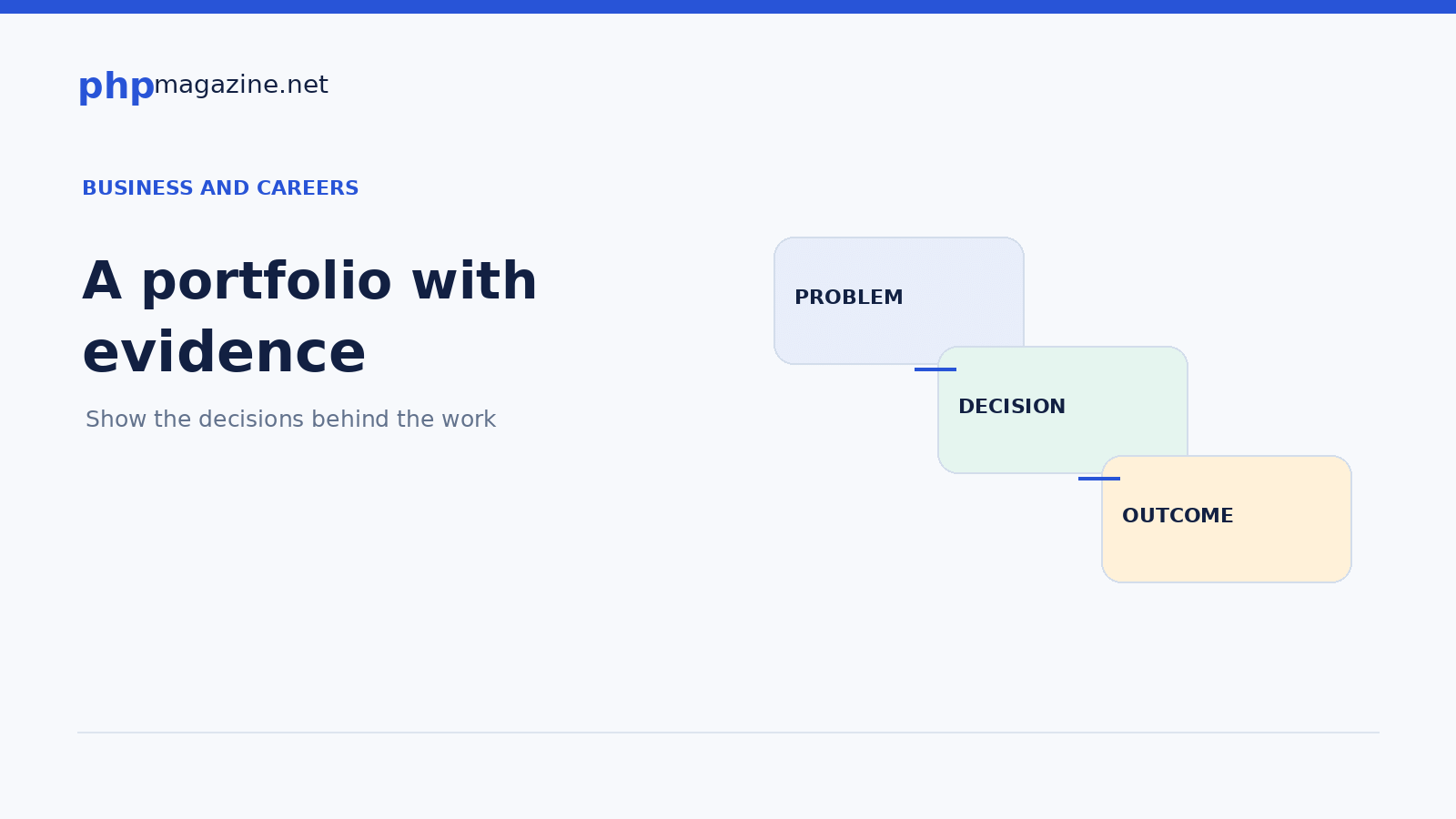
Employers and clients need evidence that you can understand a problem, make decisions under constraints, collaborate with others, and deliver something useful. A stronger portfolio makes that reasoning visible. It turns a list of projects into a small collection of case studies.
Begin with the problem
Many project descriptions start with a technology list: PHP, JavaScript, PostgreSQL, Docker, and a framework. Those details matter, but they do not tell a reader why the project existed.
Start by describing the user or business problem in plain language. Was a team manually processing orders? Were customers unable to find information on mobile devices? Did an internal application have a slow release process? A reader should understand the need before seeing the solution.
Keep the context specific without revealing confidential information. “A regional retailer needed to manage stock across two locations” is often more useful than “an innovative platform for a leading client.” If you cannot disclose the client’s identity, say so and focus on the work you are permitted to discuss.
Explain your role accurately
Web applications are usually team efforts. A case study should make it easy to distinguish the overall project from your contribution. Did you lead discovery, implement the API, improve database queries, build the interface, or coordinate releases?
Specific ownership builds credibility. “I implemented the payment integration and added failure handling” says more than “I helped build an e-commerce platform.” If the work was collaborative, name the collaboration: explaining how you worked with a designer, product owner, or another developer is evidence of professional maturity.
Show the decision and its trade-off
A useful case study includes at least one decision that was not automatic. Perhaps you chose a modular monolith because the team needed a simpler deployment process. Perhaps you used an existing open-source package rather than building a component from scratch. Perhaps you postponed an integration to deliver the core workflow sooner.
Explain the alternatives you considered and the reason for the choice. Avoid claiming that one technology was universally superior. The interesting point is how the decision fit the constraints: available time, team skills, operating costs, data requirements, or the client’s appetite for ongoing maintenance.
If you would make a different choice today, say why. An honest reflection on a limitation can be more persuasive than a case study in which every decision appears perfect.
Present outcomes you can support
Outcomes do not always need a dramatic percentage. If you have permission to share reliable measurements, describe what was measured and the relevant period. For example, explain that a report took 20 minutes to prepare manually before the project and roughly five minutes afterward, if that comparison is documented.
If you do not have reliable numbers, use a concrete qualitative outcome: the operations team could update inventory without developer assistance, a new deployment checklist reduced manual steps, or the application gained a documented recovery process. Do not invent metrics or imply that every improvement was caused solely by your work.
Give different readers a useful path
A hiring manager may want to understand your role quickly. A technical lead may want architecture details. A prospective client may care most about the problem and business result. Structure each case study so all three can find what they need.
- Overview: the problem, your role, and the result in a few sentences.
- Context: users, constraints, and the project’s purpose.
- Decisions: the approach, alternatives, and relevant technical choices.
- Outcome: what changed and what evidence supports it.
- Reflection: what you learned or would improve next.
Add screenshots, a short demonstration, or a repository link when they help explain the work and you have the right to share them. A private commercial project can still become a useful case study without exposing source code or customer data.
Three thoughtful examples can be enough
You do not need to document every project you have touched. Choose examples that demonstrate different strengths: perhaps one shows application development, another shows troubleshooting or performance work, and a third shows collaboration or product thinking.
For developers early in their careers, a personal project can be valuable if it solves a clear problem and includes the same honest account of decisions and limitations. For experienced developers, a small number of carefully chosen case studies can communicate more than a long inventory of technology logos.
A portfolio is an invitation to a professional conversation. Give the reader enough context to ask a good question, and you have already made that conversation more productive.